

Old Town Square Prague: Walking Through 1000 Years of History
Old Town Square Prague guide: explore 1000 years of history, the Astronomical Clock, Týn Church, hidden details, and essential travel tips in Prague’s historic center.
Old Town Square Prague: Walking Through 1000 Years of History
Introduction: Standing at the Heart of Prague
Some places in Europe are simply beautiful. Others feel important. Old Town Square in Prague belongs to the second category.
This is not just a central square filled with tourists, street performers, and historic buildings. It is a place where trade, religion, politics, and everyday life have intersected for over a thousand years. When you stand in the middle of the square, surrounded by Gothic towers and layered facades, you are not just looking at architecture—you are standing inside history.
What makes this square unique is not just its appearance, but its continuity. Unlike many European squares that were redesigned or rebuilt, Old Town Square has evolved gradually. Each century left something behind, and instead of replacing the past, Prague simply built on top of it.
Today, it may look like a perfectly preserved postcard. But in reality, it is a space shaped by conflict, power, and transformation.
The Origins: From Open Marketplace to Urban Core
The story of Old Town Square dates back to the 10th century, when this area was not yet a defined square, but an open marketplace located at the crossroads of major European trade routes.
Merchants traveling between Eastern and Western Europe would gather here to exchange goods such as salt, textiles, spices, and metals. The location was strategic, and over time, this temporary meeting point became a permanent center of economic activity.
As trade intensified, the space began to organize itself. By the 12th and 13th centuries, as Prague expanded and the Old Town (Staré Město) developed, the marketplace was gradually transformed into a structured urban square.
Buildings started to appear around its edges—first in Romanesque style, later replaced or expanded in Gothic architecture. Wealthy merchants and influential citizens established residences here, turning the square into both a commercial and residential hub.
But Old Town Square was never just about trade.
It quickly became a place where authority was visible and public life was controlled. Regulations were announced here. Markets were supervised here. Gatherings took place here. It functioned as the center of civic life, where economic power and political influence met.
A Stage for History: Religion, Power, and Turning Points
As Prague grew in importance, Old Town Square evolved from a marketplace into a stage where major historical events unfolded.
One of the most powerful symbols in the square today is the monument of Jan Hus. Hus was a preacher and reformer in the early 15th century who openly criticized the Catholic Church. His ideas challenged the authority of the time and inspired a broader movement for religious reform.
In 1415, he was executed for his beliefs. However, instead of silencing his influence, his death turned him into a symbol of resistance. The monument in the square is not just a tribute—it represents a key moment in Czech identity and the struggle for religious and intellectual independence.
But the square also witnessed far more brutal events.
In 1621, following the defeat of Protestant forces after the Battle of White Mountain, 27 Czech leaders were publicly executed in Old Town Square. This event marked the beginning of a long period of Habsburg rule and the suppression of Protestantism.
Today, subtle markers embedded in the ground commemorate this moment. Most visitors walk past them without noticing. But once you understand what happened here, the square begins to feel very different.
It is no longer just a beautiful space—it becomes a place where history left permanent marks.
Architectural Layers: Reading the Square Like a Timeline
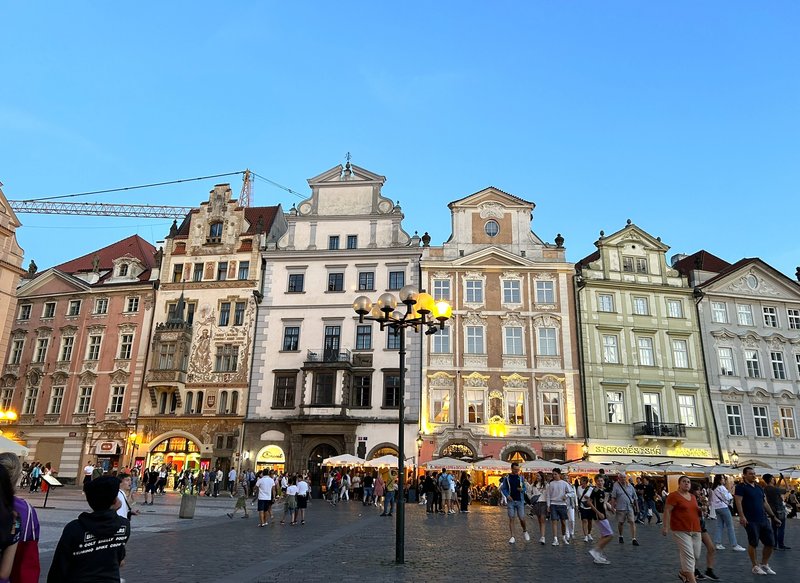
What makes Old Town Square truly unique is not just its history, but how that history is physically visible.
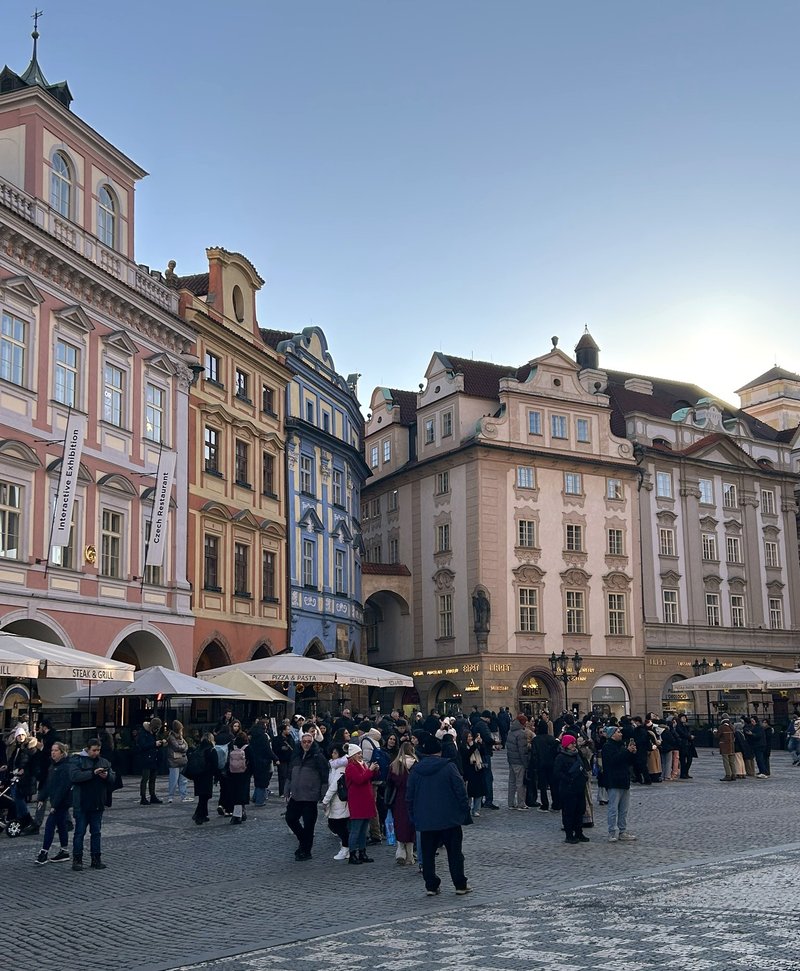
In many European cities, architectural styles are separated by districts or periods. Here, everything exists side by side. Within a few steps, you move from Gothic verticality to Baroque ornamentation, from medieval stone to later decorative facades.
This is not accidental.
Each architectural layer represents a different phase of Prague’s development. Instead of replacing older structures, the city adapted, expanded, and rebuilt on top of what already existed. As a result, the square today feels like a compressed timeline of European history.
The Astronomical Clock: A Mechanical View of the Universe
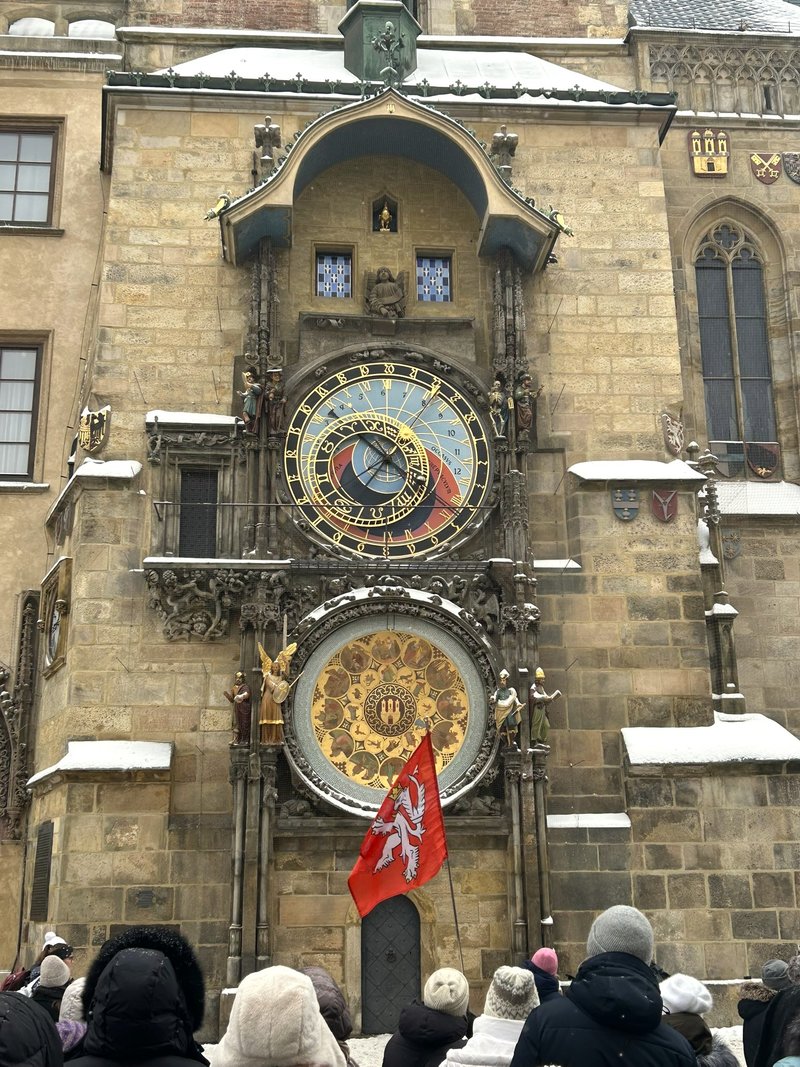
Installed in 1410, the Astronomical Clock (Orloj) is one of the oldest working clocks of its kind in the world. But calling it just a clock would be misleading.
It is a complex instrument that reflects how people in the Middle Ages understood time and the universe.
The clock displays:
- Central European time
- The position of the sun and the moon
- Zodiac signs and astronomical cycles
In other words, it is not only measuring time—it is interpreting it.
Every hour, a short mechanical performance takes place. Small figures appear, including the well-known skeleton representing death. While today this is mostly seen as a tourist attraction, its original meaning was symbolic.
The message was simple but powerful: time is passing, and life is temporary.
This reflects the deeply religious and philosophical mindset of the period.
Old Town Hall: Where the City Was Governed
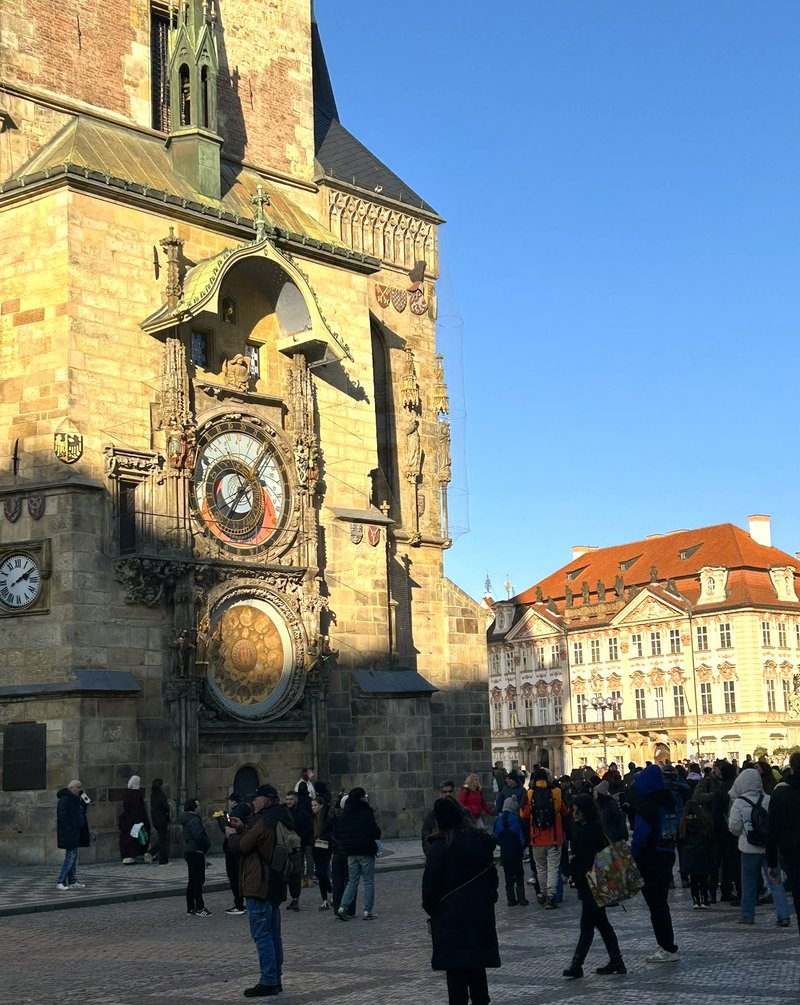
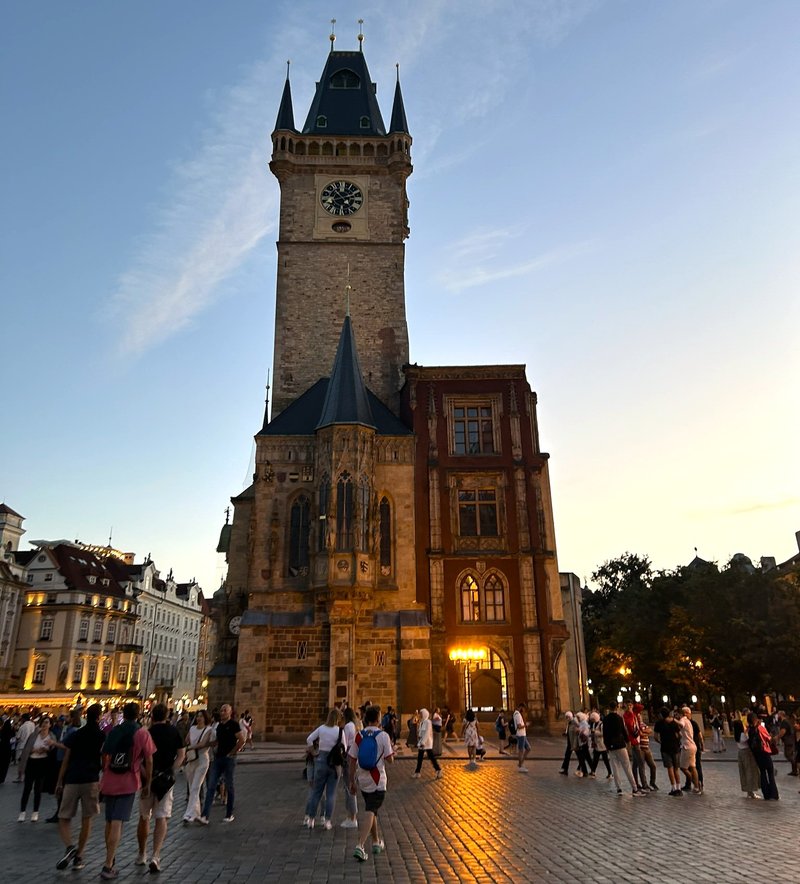
The Astronomical Clock is attached to the Old Town Hall, a building that once represented the administrative center of Prague’s Old Town.
Founded in the 14th century, this was where city officials met, decisions were made, and authority was exercised. It played a central role in shaping the political life of medieval Prague.
However, the building also carries traces of more recent history.
During the Prague Uprising in 1945, near the end of World War II, the eastern wing of the building was heavily damaged and later demolished. It was never rebuilt.
This absence is still visible today.
What you see is not just a preserved medieval structure, but a building marked by both medieval power and modern conflict.
Church of Our Lady before Týn: A Symbol in the Skyline
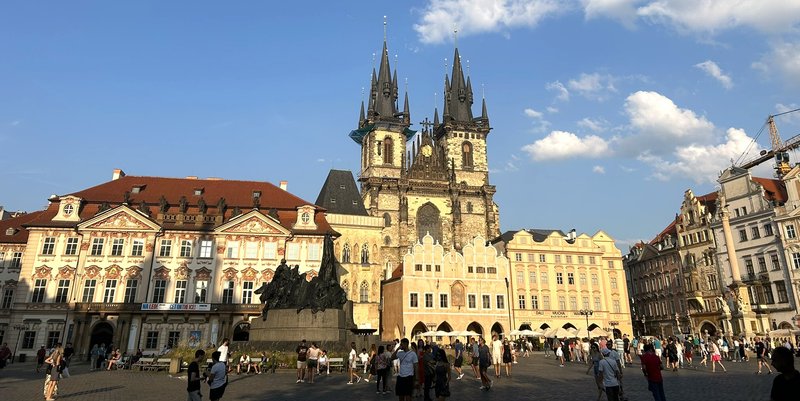
Behind the square rise the twin towers of the Church of Our Lady before Týn—one of the most recognizable silhouettes in Prague.
Built primarily in the 14th century, this Gothic church dominated the skyline of Old Town and served as a key religious center, especially during the Hussite movement.
Its towers are not perfectly symmetrical. One is slightly larger and more massive than the other. This is often interpreted as a symbolic contrast—sometimes described as representing masculine and feminine balance.
Whether intentional or not, the asymmetry adds to the visual character of the church and reinforces the idea that medieval architecture often carried deeper meanings beyond pure function.
St. Nicholas Church: Baroque Contrast
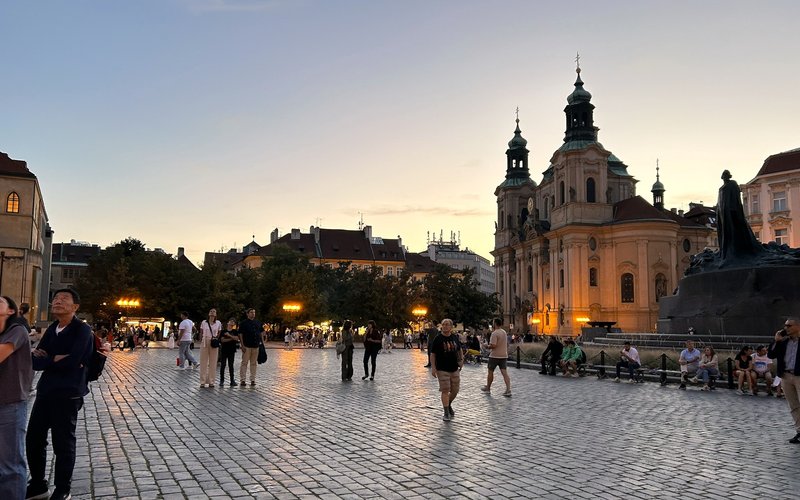
While Gothic structures dominate the square, St. Nicholas Church introduces a completely different aesthetic.
Built in the 18th century in Baroque style, it stands out with its curved forms, decorative details, and bright interior. It reflects a later period in Prague’s history—one focused on visual richness and artistic expression.
Despite its beauty, many visitors overlook it, focusing instead on more famous landmarks.
Yet this contrast is important.
It shows how the square did not remain frozen in one era. It continued to evolve, absorbing new styles and influences while maintaining its historical core.
Reading the Square: More Than Just Architecture
When you walk through Old Town Square, you are not just looking at buildings.
You are reading a layered narrative:
- Gothic structures → religious authority and medieval power
- Baroque additions → renewal and visual dominance
- Later modifications → adaptation and survival
Each facade, each tower, each missing section tells part of the story.
This is what makes the square different from a museum.
It is not curated. It is lived-in history.
The Hidden Layer: Details Most People Miss
Old Town Square is impressive at first glance. But what makes it truly memorable are the details that most visitors overlook.
This is where the square reveals its deeper identity—not through grand buildings, but through subtle traces left behind over centuries.
The Ground Beneath You: Silent Marks of Execution
In 1621, 27 Czech leaders were executed here following the events after the Battle of White Mountain.
Today, their memory is preserved in a very understated way.
If you look carefully at the ground near the Old Town Hall, you will notice a series of small crosses embedded in the pavement. There are 27 of them—each representing one of the executed leaders.
Most people walk over them without realizing what they mean.
But once you notice them, the atmosphere of the square changes.
You are no longer just standing in a tourist attraction. You are standing in a place where public executions once took place—a space where power was enforced in the most visible and brutal way.
The Legend of the Astronomical Clock
Prague Astronomical Clock
Beyond its technical complexity, the Astronomical Clock is surrounded by legend.
According to a popular story, the clockmaker—often referred to as Master Hanuš—was blinded after completing the clock. The reason? To prevent him from ever creating something equally magnificent elsewhere.
Whether historically accurate or not, the story reflects a deeper truth about the period: knowledge and craftsmanship were forms of power, and power was tightly controlled.
There is also a local belief that if the clock ever stops working, it brings bad luck to the city.
This transforms the clock from a mechanical device into something symbolic—a guardian of Prague’s continuity.
Houses Without Numbers: A Different Way of Navigating the City
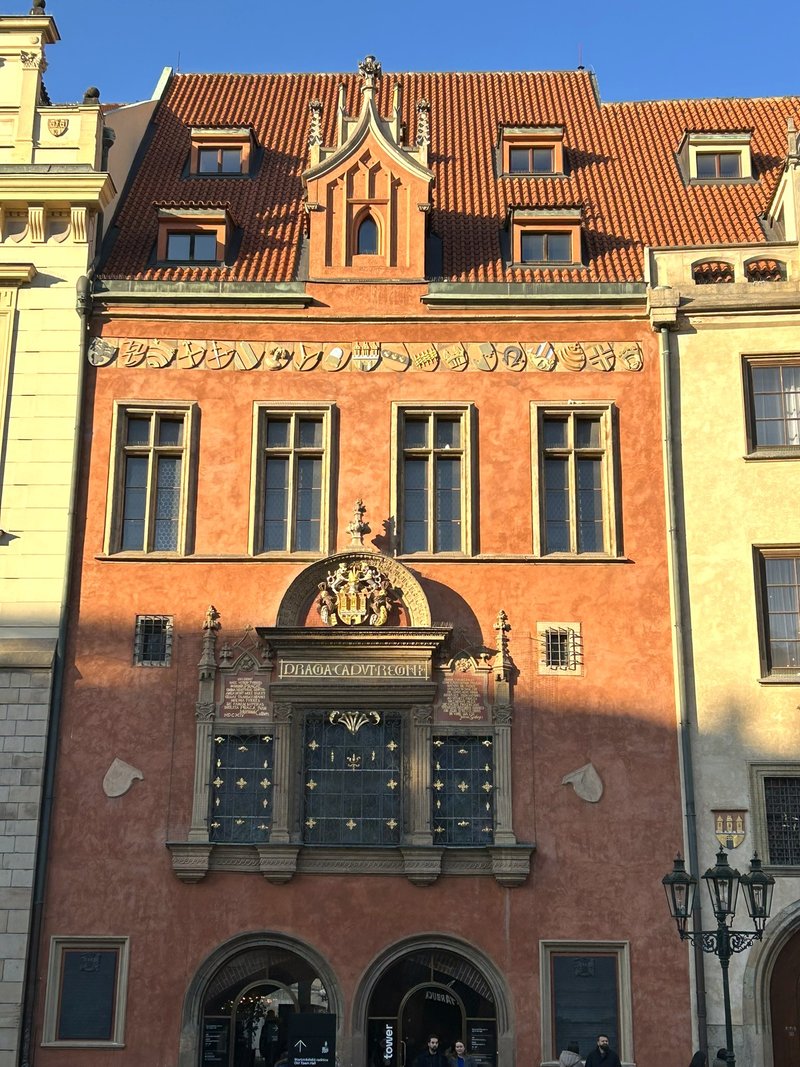
Before modern numbering systems were introduced, buildings around the square were identified by names and symbols rather than numbers.
Instead of addresses, people referred to houses using visual markers such as:
- “The House of the Golden Unicorn”
- “The House of the White Lion”
These symbols were often displayed on facades and served as a practical navigation system in a largely illiterate society.
Even today, if you pay attention to the details on certain buildings, you can still find traces of these symbols.
They are small, easy to miss, but they reveal how people once experienced and understood the city.
Markets Then and Now: A Continuity of Function
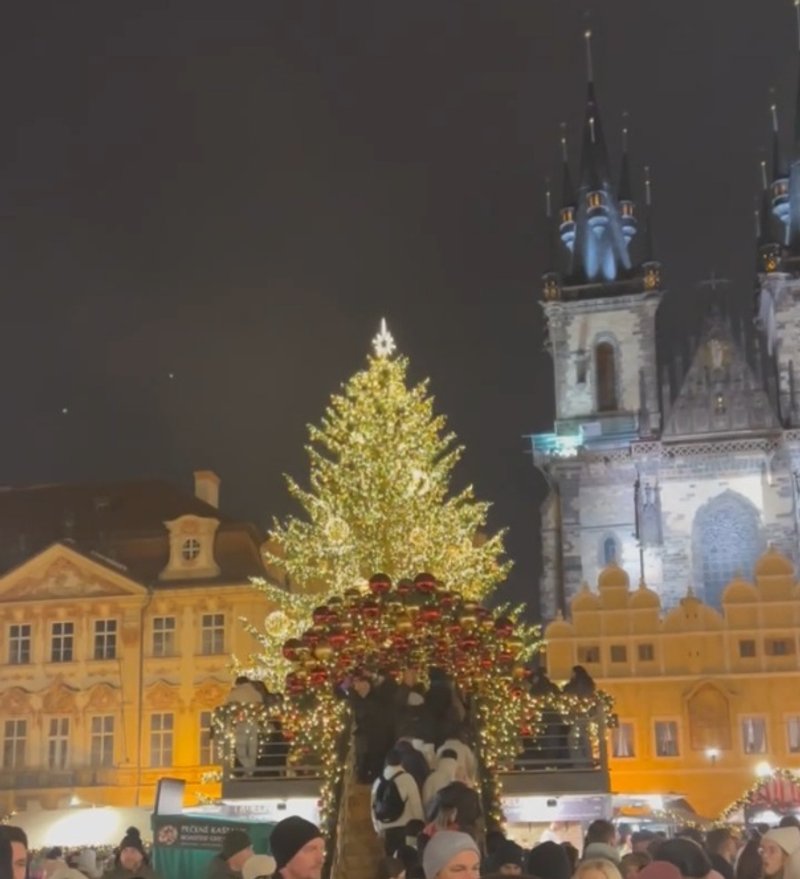
One of the most interesting aspects of Old Town Square is how its original purpose has never completely disappeared.
In the Middle Ages, this was a marketplace.
Today, during events like Christmas markets or seasonal festivals, the square once again fills with stalls, goods, and crowds.
The products have changed, the context is different, but the core idea remains the same:
This is still a place where people gather, exchange, and interact.
It is not just historically significant—it is functionally continuous.
The Reality of Crowds: A Modern Reflection of the Past
Modern visitors often see the crowds as a downside.
At peak hours, especially during midday and summer months, the square can become overwhelmingly busy. Movement slows down, space becomes limited, and the experience can feel chaotic.
But this is not entirely new.
Historically, this square was always full of people—merchants, citizens, officials, and travelers. The nature of the crowd has changed, but the density has not.
In a way, today’s tourism is simply a continuation of the square’s original role as a central meeting point.
Understanding the Square: Beyond the Surface
Old Town Square is easy to visit.
But it is not as easy to understand.
Because it is not just one thing:
- It is a marketplace
- It is a political stage
- It is a site of execution
- It is a cultural symbol
- And today, it is a global tourist attraction
All of these identities exist simultaneously.
To truly appreciate the square, you need to look beyond the obvious.
Not just at the buildings, but at the ground, the details, and the stories that are not immediately visible.
When to Visit Old Town Square: Timing Changes Everything
Visiting Old Town Square is not just about going, it is about when you go.
Because throughout the day, the square transforms completely. The same place can feel peaceful, chaotic, cinematic, or overwhelming depending on the hour.
Early Morning (07:00 – 09:00)
This is when the square feels closest to its historical self.
- Almost empty
- Minimal noise
- Soft natural light
You can walk freely, observe details, and actually notice the architecture without distraction.
If you want to understand the square, not just see, it this is the best time.
Midday (11:00 – 16:00)
This is peak tourist time.
- Large crowds gather around the Prague Astronomical Clock
- Movement becomes slow
- The atmosphere becomes loud and busy
If your goal is simply to “check it off,” this works. But in terms of experience, this is the least rewarding time to visit.
Evening & Sunset (17:00 – 21:00)
This is when the square finds balance.
- The light becomes warmer and softer
- The crowds start to thin out
- The overall atmosphere becomes more enjoyable
The silhouette of the Church of Our Lady before Týn becomes especially striking during this time.
Late Evening (After 22:00)
The square quiets down but never fully empties.
- Fewer tourists
- A calmer, more reflective atmosphere
- A different, almost cinematic feeling
This is when the square feels less like a tourist site and more like a living part of the city.
Practical Tips: How to Experience the Square Properly
To get more than just a surface-level visit, a few small decisions make a big difference:
- Watch the Astronomical Clock show only once more is unnecessary
- Don’t stop immediately at the center; walk around first, then return
- Look down as much as you look up important details are on the ground
- Step inside at least one building, not just admire from outside
Most importantly:
Do not rush.
This is not a place to pass through, it is a place to pause.
If You’re Like Me
If you approach travel the same way I do, this square will affect you differently.
- If you dislike crowds → come early in the morning
- If photography matters → aim for sunset
- If you enjoy history → spend at least an hour here
- If you care about details → slow down and observe everything
And one more thing:
Don’t just look at the skyline.
Some of the most important stories are right beneath your feet.
Final Thoughts: Where Prague Begins
Old Town Square is not just one of the places to see in Prague.
It is the place where Prague begins.
- A marketplace that shaped the city
- A stage where power was displayed
- A site where lives were taken
- And today, a place where people gather from all over the world
What makes it powerful is not just what it is today, but everything it has been.
When you walk through this square, you are not just visiting a landmark.
You are moving through layers of time.
And that is why, even after you leave Prague, this is often the place that stays with you the longest.


